
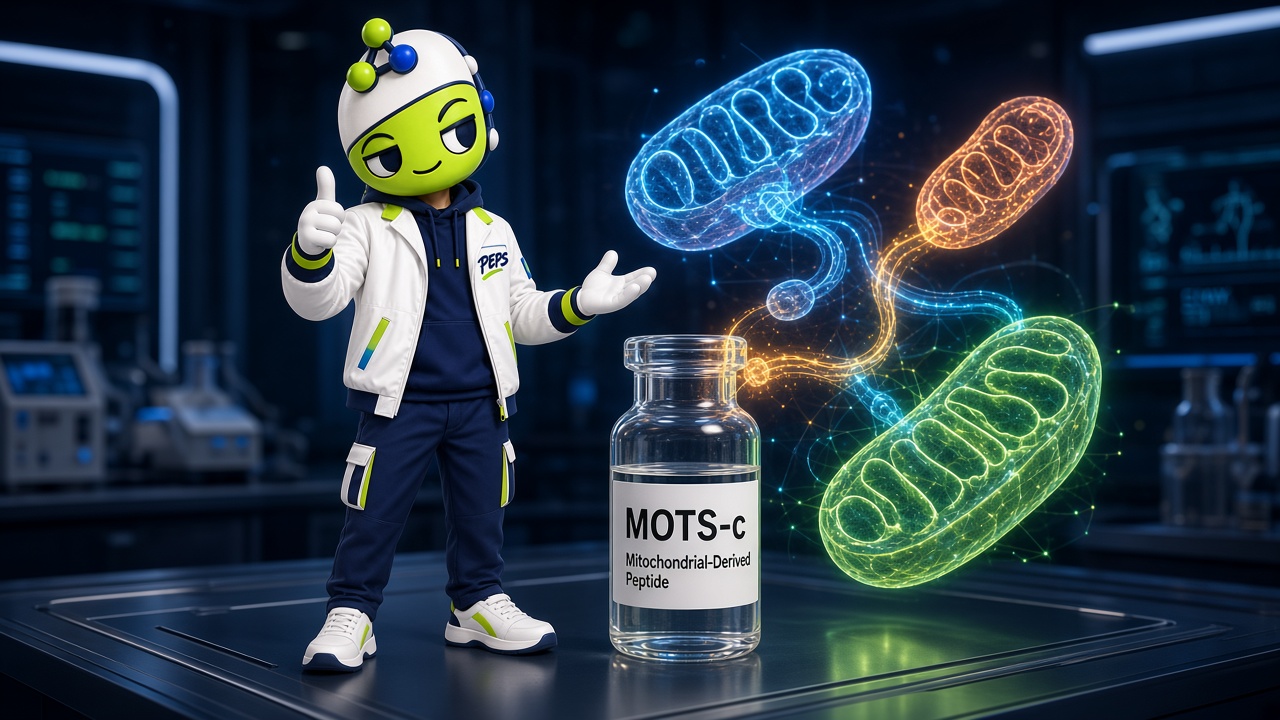
Mitochondrial Open Reading Frame of the 12S rRNA-c (MOTS-c) is one of the most remarkable discoveries in modern biogerontology. Unlike traditional nuclear-encoded peptides, MOTS-c is a 16-amino-acid peptide encoded within the mitochondrial genome itself. In pre-clinical literature, it functions as a mitochondrial hormone (mitokine) that regulates systemic metabolic homeostasis, activates AMP-activated protein kinase (AMPK), and enhances cellular bioenergetics. However, MOTS-c is notoriously fragile in laboratory handling.
The Biochemical Mechanism: How MOTS-c Governs Cellular Energy
Mitochondria produce cellular ATP through oxidative phosphorylation, but MOTS-c serves as an adaptive metabolic signaling messenger that crosses the mitochondrial membrane into the nucleus:
- AMPK Pathway Phosphorylation: MOTS-c targets the folate cycle to alter de novo purine biosynthesis, which increases cellular 5-aminoimidazole-4-carboxamide ribonucleotide (AICAR) levels and directly stimulates AMPK phosphorylation.
- Glucose Uptake & Insulin Sensitivity: Pre-clinical rodent models demonstrate that MOTS-c stimulates muscle glucose clearance independent of traditional insulin signaling cascades.
- Resistance to Metabolic Stress: Under nutrient deprivation or heat shock, MOTS-c translocates directly to the cell nucleus to regulate expression of antioxidant response genes.
Thermal Fragility & The MOTS-c Reconstitution Dilemma
Among research peptides, MOTS-c (molecular weight 2174.65 Da) is exceptionally sensitive to thermal degradation and mechanical shear stress. Many researchers inadvertently ruin their vials by reconstituting with warm bacteriostatic water or vigorous shaking:
Critical Cold Handling Rule for MOTS-c
Always chill your bacteriostatic water vial in the refrigerator (2°C to 8°C) before reconstitution. Injecting room-temperature diluent into lyophilized MOTS-c can cause rapid aggregation. Let the diluent trickle down the vial wall and allow 10–15 minutes for self-dissolution with zero shaking.
MOTS-c Reconstitution & Syringe Measurement Chart
| Vial Size | Chilled Bac Water Added | Resulting Concentration | Units on U-100 Syringe per 1.0 mg Target |
|---|---|---|---|
| 5 mg Vial | 1.0 mL | 5.0 mg/mL (5,000 mcg/mL) | 20 Units (0.20 mL) = 1.0 mg |
| 5 mg Vial | 2.0 mL | 2.5 mg/mL (2,500 mcg/mL) | 40 Units (0.40 mL) = 1.0 mg |
| 10 mg Vial | 2.0 mL | 5.0 mg/mL (5,000 mcg/mL) | 20 Units (0.20 mL) = 1.0 mg |
| 10 mg Vial | 2.5 mL | 4.0 mg/mL (4,000 mcg/mL) | 25 Units (0.25 mL) = 1.0 mg |
| 10 mg Vial | 4.0 mL | 2.5 mg/mL (2,500 mcg/mL) | 40 Units (0.40 mL) = 1.0 mg |
Storage Protocols & Purity Verification
Because MOTS-c degrades faster than standard peptides, reconstituted liquid must be consumed in experimental protocols within 14 to 21 days of mixing, stored continuously at 2°C to 8°C in amber or foil-wrapped glass vials. When inspecting a Janoshik COA, verify that the HPLC chromatogram indicates ≥98.0% purity with zero degradation shoulder peaks.