
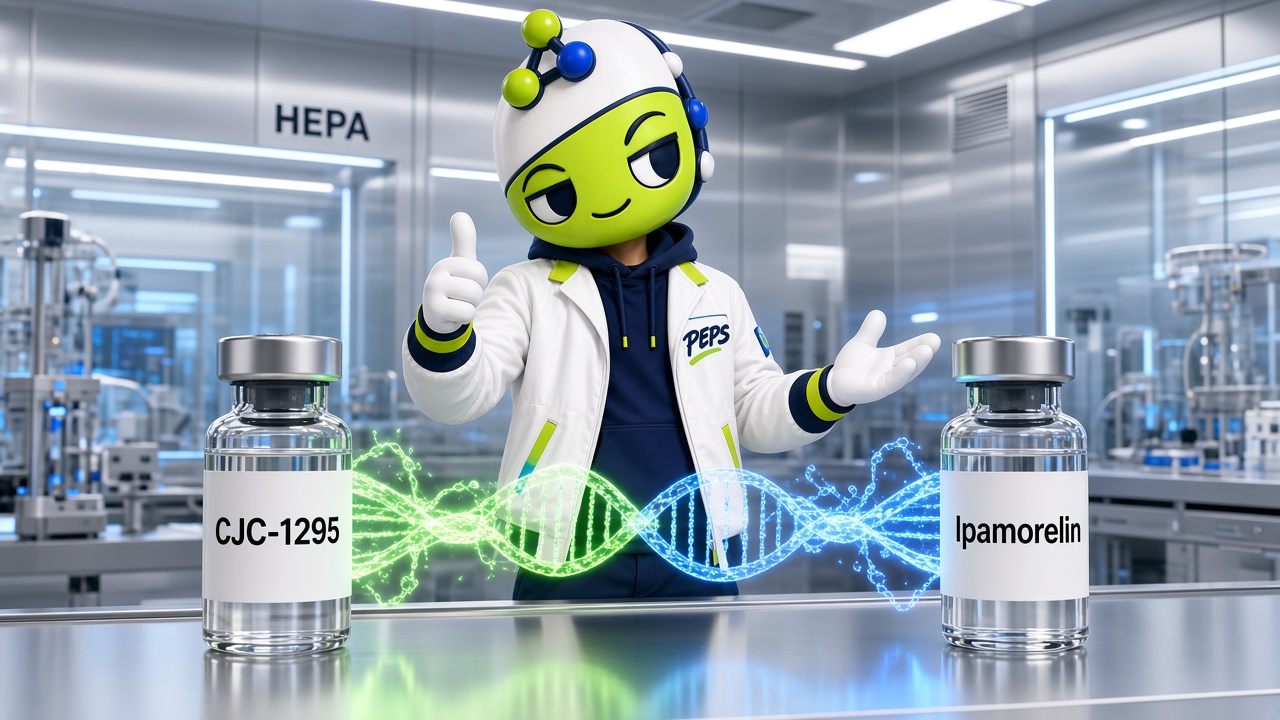
The combination of CJC-1295 and Ipamorelin is the most widely investigated dual-secretagogue peptide stack in biological research, generating over 100,000 monthly combined searches. By simultaneously targeting two distinct neuroendocrine pathways — Growth Hormone Releasing Hormone (GHRH) receptors and Growth Hormone Secretagogue Receptors (GHSR / Ghrelin) — this stack creates a synergistic release of endogenous growth hormone that neither compound can achieve in isolation.
The Synergy Mechanism: Dual-Pathway Receptor Kinetics
In mammalian physiology, growth hormone release from anterior pituitary somatotroph cells is governed by an exquisite checks-and-balances system. Combining CJC-1295 with Ipamorelin produces a multiplicative biochemical response:
- GHRH Receptor Agonism (CJC-1295): CJC-1295 stimulates the synthesis and transcription of growth hormone within somatotroph cells, priming them with stored secretory granules.
- GHSR-1a Agonism (Ipamorelin): Ipamorelin binds selectively to the ghrelin receptor, triggering immediate exocytosis (release) of the granules primed by CJC-1295 while simultaneously blunting the inhibitory effects of somatostatin.
- Selective Endocrine Cleanliness: Unlike older first- and second-generation secretagogues (such as GHRP-2 or GHRP-6), Ipamorelin exhibits near-complete selectivity for GH release without stimulating cortisol, prolactin, or ACTH elevations.
CJC-1295 with DAC vs. CJC-1295 No DAC (Mod GRF 1-29)
A critical distinction that frequently confuses researchers is the difference between CJC-1295 with Drug Affinity Complex (DAC) and without DAC (commonly known as Modified GRF 1-29):
| Parameter / Characteristic | CJC-1295 No DAC (Mod GRF 1-29) | CJC-1295 with DAC (Drug Affinity Complex) |
|---|---|---|
| Terminal Half-Life | Approximately 30 minutes in vivo | Approximately 6 to 8 days in vivo |
| Receptor Kinetics | Produces sharp, physiological pulses of GH release | Produces continuous, non-pulsatile elevated baseline GH levels ("GH Bleed") |
| Molecular Structure | 29-amino-acid synthetic analog with 4 D-isomer substitutions | Mod GRF 1-29 sequence linked to maleimidopropionic acid at the C-terminus |
| Serum Binding | Circulates freely in plasma | Binds covalently to endogenous serum albumin molecules |
| Best Used With | Ideal partner for Ipamorelin to mimic natural biological pulses | Investigated primarily for extended multi-day systemic GH elevation |
Reconstitution & Syringe Mixing Math for the Stack
Researchers frequently ask whether CJC-1295 and Ipamorelin can be reconstituted together in the same vial or mixed in the same syringe:
Laboratory Reconstitution Best Practice
Never mix dry lyophilized powders together before reconstitution. Always reconstitute CJC-1295 (e.g. 2mg vial + 2mL bac water = 1mg/mL) and Ipamorelin (e.g. 5mg vial + 2.5mL bac water = 2mg/mL) in their separate dedicated vials. They can be drawn sequentially into the same sterile syringe immediately prior to experimental application without chemical interaction.
Purity Degradation & Testing Protocols
CJC-1295 is especially susceptible to oxidation at its methionine residue (Met8), which can rapidly degrade purity below research thresholds if exposed to air or heat. Authentic batches must be confirmed through reverse-phase HPLC with certified baseline separation.