
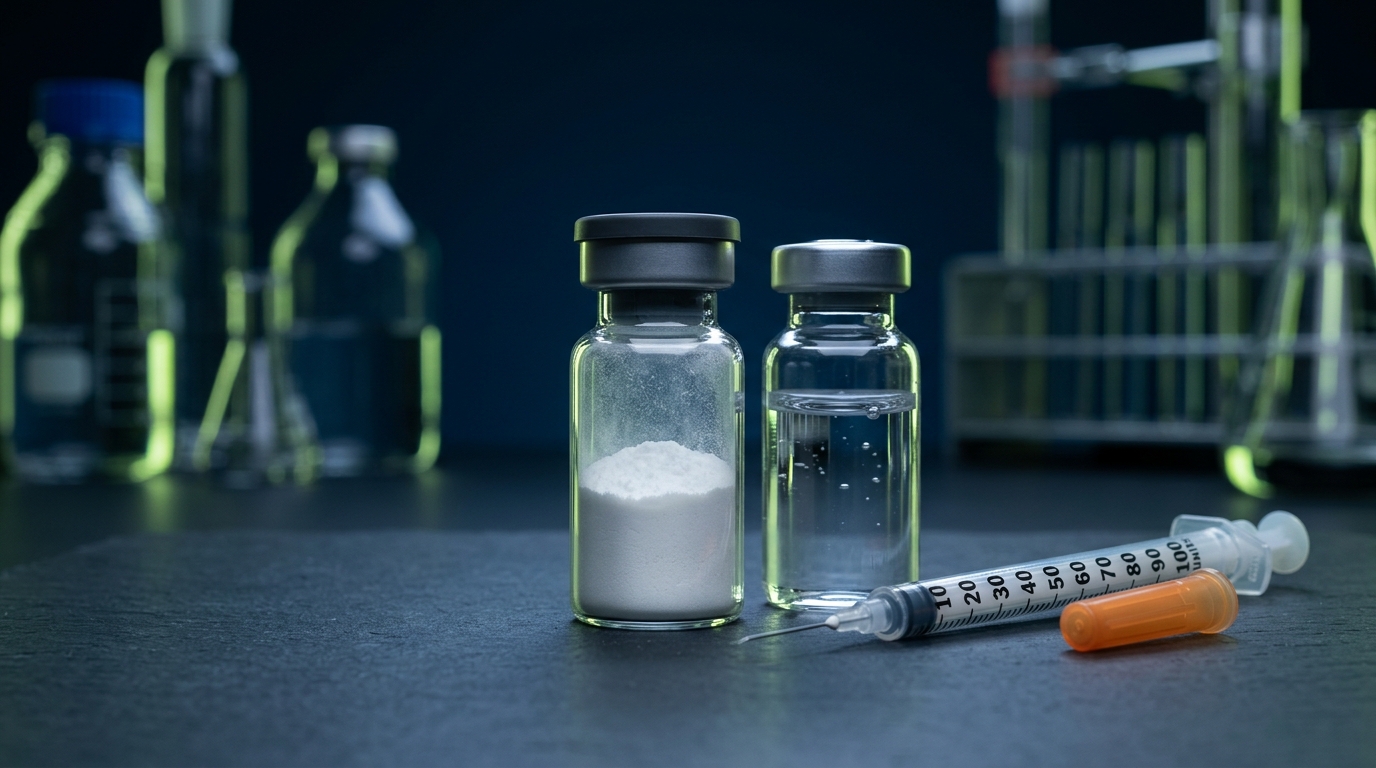
Lyophilized (freeze-dried) research peptides arrive as a stable solid cake in a sterile glass vial. Before any laboratory assessment or measurement can take place, the peptide must be reconstituted with a precise volume of bacteriostatic water (sterile water containing 0.9% benzyl alcohol to prevent microbial growth). Determining the exact liquid volume and measuring accurate syringe units requires precise mathematical ratios.
The Universal Peptide Reconstitution Formula
The core relationship between vial content, liquid added, and desired concentration is governed by a straightforward equation:
Formula: Concentration (mg/mL) = Total Peptide in Vial (mg) ÷ Volume of Bac Water (mL)
For example: If you reconstitute a 10 mg vial of peptide with 2 mL of bacteriostatic water, your resulting concentration is exactly 5 mg/mL (10 mg ÷ 2 mL = 5 mg/mL, or 5,000 mcg/mL).
Converting Milligrams (mg) to Syringe Units (U-100)
Most standard research measurement tools utilize U-100 insulin syringes, where 100 units equal exactly 1.0 mL (each individual tick mark represents 0.01 mL). To determine how many units on a U-100 syringe correspond to your desired measurement amount:
| Target Amount (mcg) | 10mg Vial + 1mL Bac Water | 10mg Vial + 2mL Bac Water | 5mg Vial + 2mL Bac Water |
|---|---|---|---|
| 100 mcg (0.1 mg) | 1 Unit (0.01 mL) | 2 Units (0.02 mL) | 4 Units (0.04 mL) |
| 250 mcg (0.25 mg) | 2.5 Units (0.025 mL) | 5 Units (0.05 mL) | 10 Units (0.10 mL) |
| 500 mcg (0.50 mg) | 5 Units (0.05 mL) | 10 Units (0.10 mL) | 20 Units (0.20 mL) |
| 1,000 mcg (1.00 mg) | 10 Units (0.10 mL) | 20 Units (0.20 mL) | 40 Units (0.40 mL) |
Live U-100 Reconstitution Calculator
Step-by-Step Reconstitution Protocol
- Step 1: Sanitize Work Surfaces and Vial Tops — Clean the rubber stoppers of both the bacteriostatic water and peptide vials with 70% isopropyl alcohol swabs. Allow 30 seconds to air-dry completely.
- Step 2: Draw the Reconstitution Water — Use a sterile syringe to draw the exact measured volume of bacteriostatic water.
- Step 3: Slow Glass Wall Dispersion — Angle the needle so the liquid gently dribbles down the inside glass wall of the vial. Never spray liquid directly into the lyophilized powder cake, as violent turbulence can shear delicate peptide chains.
- Step 4: Equalize Vacuum Pressure — Lyophilized vials frequently have negative vacuum pressure. Allow air to gently equalize through the syringe before withdrawing the needle.
- Step 5: Gentle Dissolution — Gently swirl the vial between your fingers. Never shake or agitate vigorously. Once completely clear and free of suspended particles, store immediately in dark refrigeration at 2°C to 8°C (36°F to 46°F).
The Marketplace Problem: Why Counterparty Protection Matters
Even with perfect reconstitution technique, research outcomes depend entirely on supplier authenticity and chemical purity. Traditional peptide suppliers frequently suffer from payment processor freezes, chargeback disputes, and inconsistent third-party testing.