
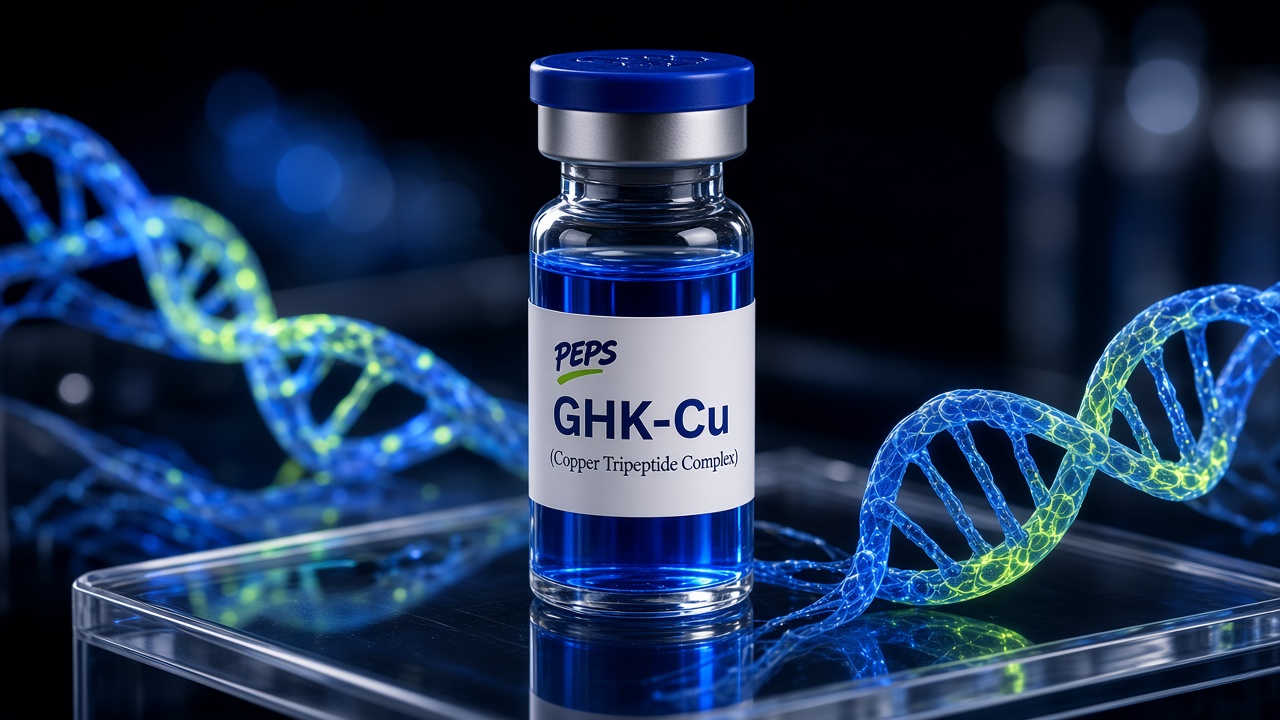
Discovered in 1973 by Dr. Loren Pickart, Glycyl-L-Histidyl-L-Lysine-Cu(II) (GHK-Cu) is a naturally occurring plasma tripeptide with extraordinarily high affinity for copper ions. Generating over 60,000 monthly search queries, GHK-Cu has become a foundational compound in tissue remodeling, collagen fibrillogenesis, wound-repair research, and epigenetic gene modulation.
The Science of GHK-Cu: Epigenetic Gene Modulation
GHK-Cu acts as a biological signal peptide that regulates over 4,000 human genes, essentially resetting cellular transcription towards younger, healthier expression profiles:
- Collagen & Elastin Up-Regulation: Stimulates synthesis of collagen type I, type III, and elastin in dermal fibroblasts more effectively than vitamin C or retinoic acid.
- Glycosaminoglycan (GAG) Production: Dramatically increases hyaluronic acid and chondroitin sulfate production in extracellular matrix scaffolding.
- Matrix Metalloproteinase Balance: Up-regulates both MMPs (which clear damaged tissue) and TIMPs (which inhibit excessive collagen degradation), promoting true scarless tissue remodeling.
Spotting Counterfeits: The Royal Blue Color Signature
Unlike almost all other research peptides (which arrive as pure white lyophilized powder cakes), authentic GHK-Cu exhibits a distinct, vibrant visual signature:
| Visual & Chemical Trait | Authentic Chelation (Genuine GHK-Cu) | Counterfeit / Unchelated Fake |
|---|---|---|
| Dry Cake Color | Distinct intense royal blue or sky blue crystalline cake | White, beige, or dull gray powder |
| Reconstituted Solution | Crystal clear, transparent brilliant sapphire blue liquid | Cloudy pale blue, milky, or completely clear transparent liquid |
| Copper Ion Stoichiometry | Exact 1:1 molar chelation ratio of GHK tripeptide to Cu²⁺ ion | Unbound free copper sulfate mixed with cheap filler powder |
| Injection Sting (SubQ) | Known mild localized post-injection ache due to copper chelation | Zero sensation (indicates pure filler powder like mannitol) |
Reconstitution & Formulation Math (1% vs. 3% Solutions)
GHK-Cu is commonly formulated into percentage-based concentrations for dermatological research assays. Understanding the relationship between milligrams and milliliters is vital:
Percentage Concentration Formula: 1% = 10 mg/mL
• To make a 1% solution (10 mg/mL): Dissolve a 100 mg GHK-Cu vial in exactly 10.0 mL of sterile bacteriostatic water or serum base. • To make a 2% solution (20 mg/mL): Dissolve a 100 mg GHK-Cu vial in exactly 5.0 mL of diluent. • To make a 3% solution (30 mg/mL): Dissolve a 150 mg GHK-Cu vial in 5.0 mL of diluent.
Subcutaneous Research Protocol Dilution
For subcutaneous systemic research, high concentrations (e.g. 50mg in 1mL) cause significant post-injection soreness due to localized copper osmolarity. Diluting a 50 mg vial with 3.0 mL to 5.0 mL of bacteriostatic water buffers the solution and eliminates tissue irritation.