
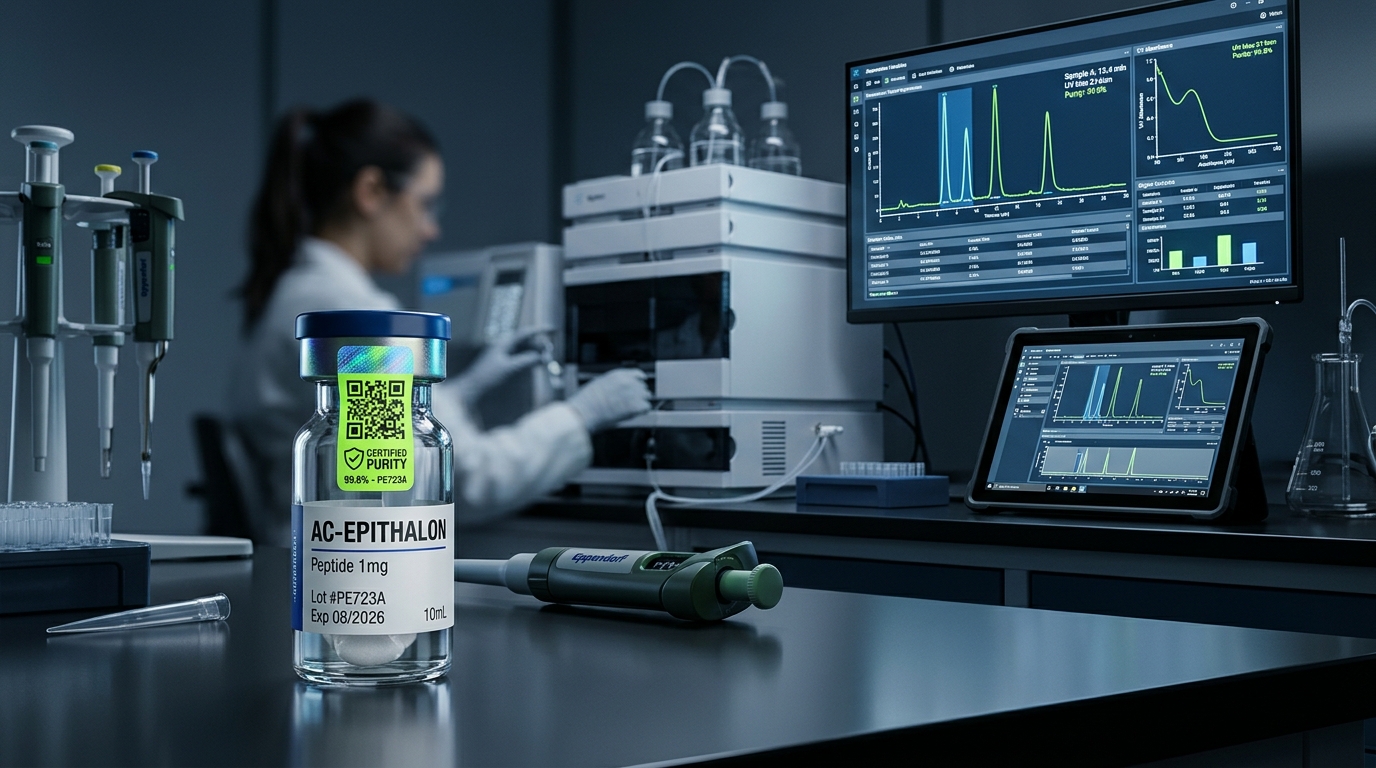
In the unregulated research peptide sector, a Certificate of Analysis (COA) is the sole piece of documentation standing between high-grade research compounds and dangerous counterfeit or underdosed vials. Yet over 60% of online peptide certificates are fabricated, photoshopped, or recycled across batches. Understanding how to interpret authentic analytical chemistry reports — specifically those from industry gold standard laboratory Janoshik — is essential for every researcher.
The Two Halves of Real Peptide Analysis: HPLC vs. Mass Spectrometry
A legitimate peptide COA must contain two distinct analytical tests to prove both that the compound is pure, and that it is actually the intended chemical molecule:
- High-Performance Liquid Chromatography (HPLC): Measures Chemical Purity (%). HPLC separates every chemical component in a dissolved sample through a pressurized column. The resulting graph displays peaks corresponding to each detected substance. Purity is calculated by dividing the area under the primary peptide peak by the total area of all detected peaks combined.
- Mass Spectrometry (MS): Confirms Molecular Identity & Mass (Da). Even if a vial is 99% pure, HPLC alone cannot tell you what the compound is — it could be pure BPC-157, or pure caffeine. Mass spectrometry bombards the sample to measure the exact mass-to-charge ratio (m/z) and calculates total molecular weight. If your target peptide has a theoretical weight of 1419.5 Da and the MS report reads 1419.6 Da, chemical identity is confirmed.
Step-by-Step Breakdown of a Janoshik Analytical Report
Janoshik Analytical is widely regarded across the global peptide community as the most reliable independent third-party laboratory. Here is how to audit each section of an official Janoshik report:
| Report Section | Key Field to Inspect | Expected Standard / Warning Sign |
|---|---|---|
| Header & Task ID | Unique Task ID & Issue Date | Unique numeric Task ID that matches Janoshik database query; date matches current vendor batch |
| Client Name | Submitting Vendor or Blind Researcher | Matches the vendor name or verified community group-buy coordinator |
| Quantitative HPLC Peak | Purity Percentage (Area %) | Gold Standard: ≥98.5% purity. Red Flag: Peak graphs with wide shoulders or multiple secondary peaks (>1.5%) |
| Quantity per Vial | Total Net Milligram Weight (mg) | Measured active peptide content (e.g. 10.4 mg in a nominal 10 mg vial). Lyophilization fillers (mannitol) must be excluded from active count |
| Mass Spec Readout | Experimental Mass vs Theoretical Mass | Variance should be within ±0.5 Da of theoretical peptide mass (e.g., Retatrutide theoretical 4731.33 Da) |
| Cryptographic Verification | Unique Verification Key & QR Code | Must link directly to janoshik.com verification portal showing an identical digital report |
How Rogue Vendors Forge COAs (And How to Catch Them)
Scam suppliers employ several predictable tactics to deceive researchers without paying for real analytical testing:
The Three Most Common COA Forgery Methods
1. The PDF Photoshop Swap: Modifying the client name, batch number, or date on an old report while keeping another vendor’s legitimate graph. 2. The Single-Batch Bait-and-Switch: Ordering 100 high-purity vials from a cGMP lab to get a flawless 99.2% test result, then fulfilling subsequent retail orders with cheap, unpurified 80% overseas batches. 3. Blind Manufacturer Testing: Displaying an in-house factory sheet from a Chinese chemical exporter instead of an independent accredited Western third-party lab.
The PeptideSwap Protocol: Decentralized Proof-of-Purity
Instead of trusting static PDF uploads that can be altered with image editing software, PeptideSwap integrates analytical verification directly into smart contract settlement.
- On-Chain Hash Anchoring: Verified vendor lab reports are cryptographically hashed and anchored on IPFS and the blockchain, creating an immutable history of batch purity.
- Community-Funded Blind Testing: The PeptideSwap DAO Treasury routinely allocates funds to blind-purchase random retail vials from listed vendors and submit them directly to Janoshik for unannounced testing.
- Automatic Delisting & Slashing: Vendors must stake $PEPS tokens to maintain verified seller status. If a blind test reveals underdosing or impurities below protocol thresholds, the vendor is instantly suspended and their staked tokens are slashed.