
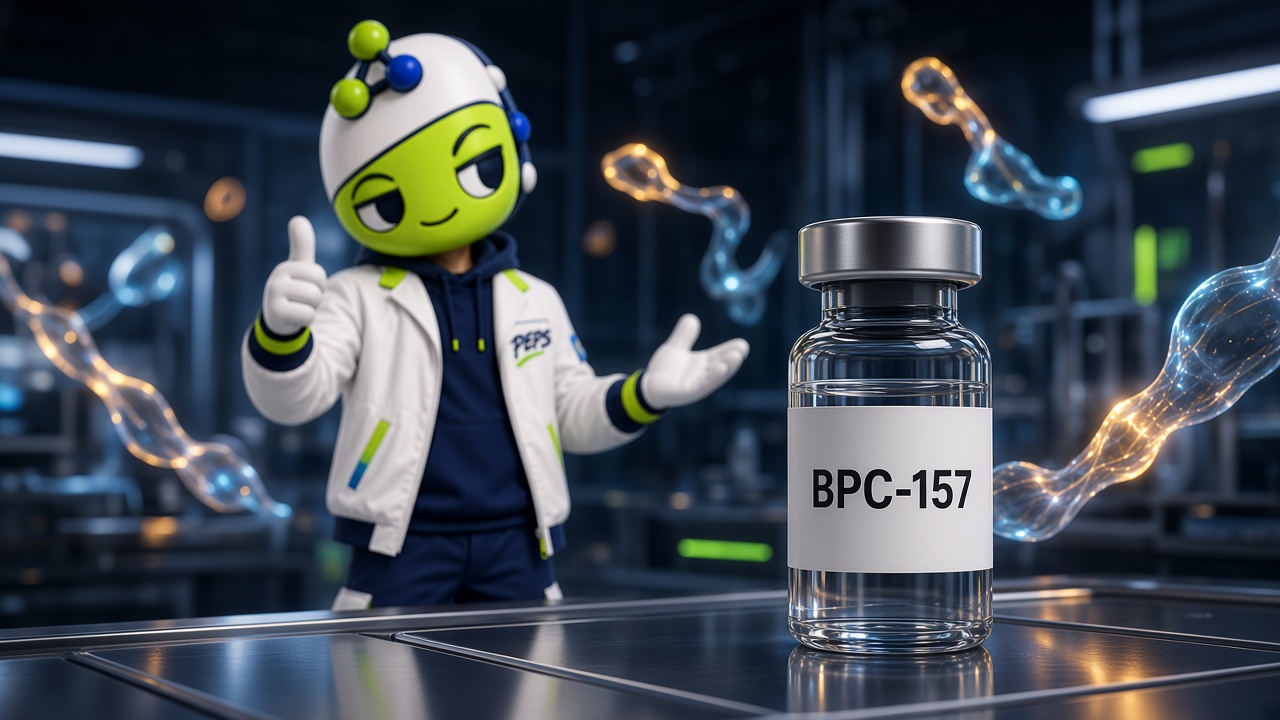
Body Protection Compound-157 (BPC-157) is by far the most searched research peptide globally, generating over 165,000 monthly search queries. Because of this massive demand, it has also become the single most counterfeited and adulterated research chemical on the market. Navigating where to buy authentic BPC-157 requires strict chemical literacy and knowledge of supplier validation standards.
The Chemical Difference: BPC-157 Acetate vs. Stable BPC-157 Arginate Salt
Most commercial suppliers sell BPC-157 in its basic acetate salt form. While acetate is inexpensive to synthesize, it possesses significant chemical fragility compared to advanced arginate formulations:
| Property / Feature | Standard BPC-157 Acetate Salt | Stable BPC-157 Arginate Salt (L-Arginine) |
|---|---|---|
| Chemical Stability | Degrades rapidly when exposed to gastric acid (pH < 3.0) | Highly resilient to low-pH gastric acid; >90% intact after 5 hours in simulated gastric juice |
| Thermal Resilience | Begins degrading within 14 days at room temperature (25°C) | Maintains structural integrity for up to 12 months at room temperature |
| Lyophilization Cake | Fluffy white crystalline powder | Dense, compact off-white to yellowish crystalline cake |
| Synthesis Cost | Standard chemical synthesis cost ($10–$25 per 5mg vial raw) | Advanced counter-ion binding synthesis ($35–$65 per 5mg vial raw) |
| Authenticity Risk | Heavily counterfeited; frequently cut with mannitol or glycine fillers | Rarely faked due to unique mass spectrometry signature and polarity shift |
The 5-Step Sourcing Checklist for BPC-157 Buyers
- Step 1: Check the Mass Spec Dalton Signature — The theoretical molecular weight of BPC-157 (C62H98N16O22) is exactly 1419.53 Da. Any laboratory certificate showing a molecular weight deviating by more than ±0.5 Da indicates a completely different peptide sequence or severe synthesis impurities.
- Step 2: Inspect HPLC Peak Purity — Purity must exceed 98.5%. Be wary of test reports displaying a single broad peak without an expanded baseline — rogue labs deliberately zoom out HPLC baselines to hide 5%–10% synthesis truncations.
- Step 3: Verify the Net Active Milligram Content — Many vendors sell "5 mg vials" that contain 100 mg of total powder (95 mg mannitol filler + 5 mg peptide). However, disreputable suppliers frequently dose only 1.5 mg to 2.5 mg of active peptide into the cake. Insist on a quantitative lab report stating exact active milligrams.
- Step 4: Demand a Verifiable Independent Lab Key — Never rely on certificates printed by the vendor. Authentic test results from accredited labs like Janoshik include a unique verification key verifiable directly on the lab’s official domain.
- Step 5: Never Send Unprotected Wire Transfers — Legitimate suppliers do not require risky Zelle, CashApp, or irreversible direct cryptocurrency transfers without buyer escrow protection.
Reconstitution & Syringe Measurement Math for BPC-157
For pre-clinical laboratory assays, BPC-157 is conventionally reconstituted to allow micro-measurement without excessive diluent volume:
Standard BPC-157 5mg Vial Calculation
Adding 2.0 mL of bacteriostatic water to a 5 mg vial yields a concentration of 2.5 mg/mL (2,500 mcg/mL). On a standard U-100 syringe (where 100 units = 1.0 mL): • 10 Units = 250 mcg (0.25 mg) • 20 Units = 500 mcg (0.50 mg) • 40 Units = 1,000 mcg (1.00 mg)
How PeptideSwap Protects BPC-157 Researchers
PeptideSwap provides a decentralized, peer-to-peer marketplace where certified suppliers stake $PEPS tokens to list their batches. Buyer payments are held in multi-sig escrow until delivery is confirmed and community lab audits verify chemical authenticity.