
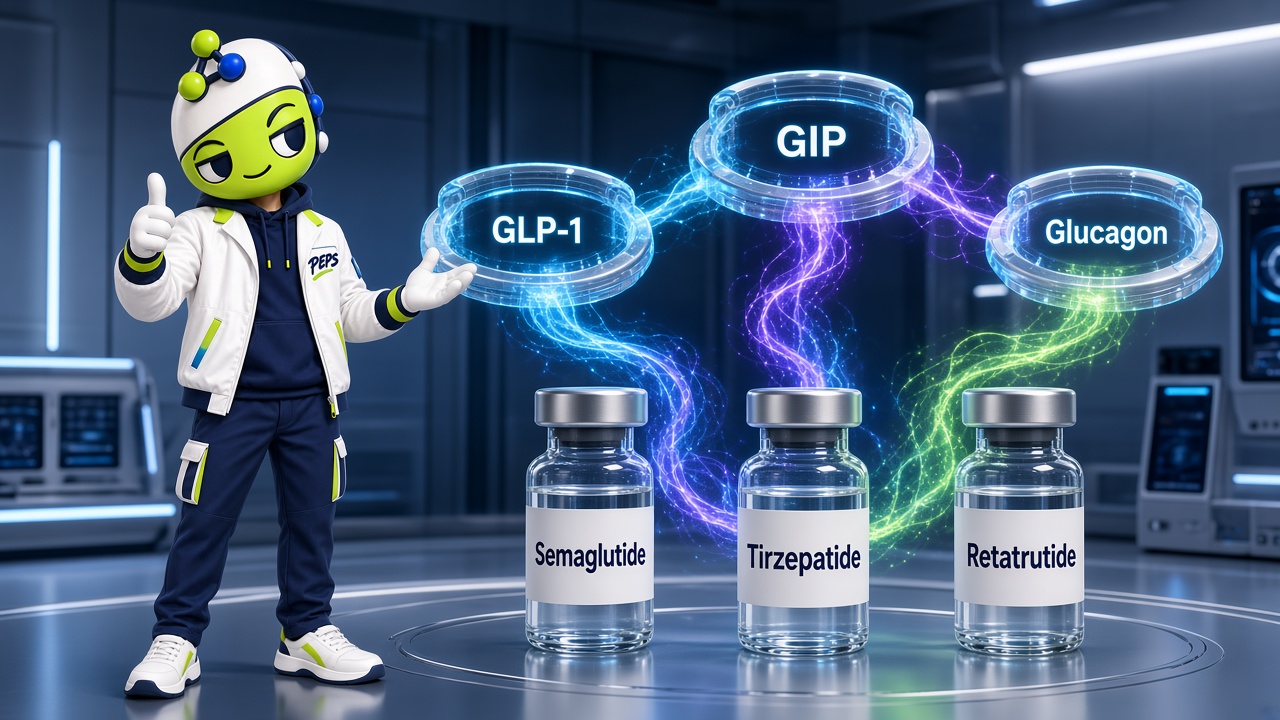
Over the past five years, metabolic biomedical research has undergone a historic revolution. The progression from single-hormone receptor agonists (Semaglutide) to dual agonists (Tirzepatide) and now triple agonists (Retatrutide) represents one of the most rapid evolutions in modern pharmacology. Understanding the kinetic differences, receptor binding affinities, and sourcing realities of these three benchmark molecules is essential for every researcher.
Receptor Agonism Evolution: From Single to Triple Agonist
| Molecule / Compound | Target Receptors | Peptide Chain Length | Terminal Half-Life | Mechanism of Action |
|---|---|---|---|---|
| Semaglutide (Generation 1) | GLP-1 Receptor Only | 31 amino acids + C18 diacid chain | Approximately 7 days | Selectively delays gastric emptying, stimulates insulin, suppresses glucagon |
| Tirzepatide (Generation 2) | Dual GLP-1 + GIP Receptors | 39 amino acids + C20 diacid chain | Approximately 5 days | Synergistic incretin agonism; GIP improves insulin sensitivity and reduces nausea |
| Retatrutide (Generation 3) | Triple GLP-1 + GIP + Glucagon Receptors | 39 amino acids + C20 diacid chain | Approximately 6 days | Triple agonism; Glucagon receptor stimulation dramatically increases hepatic energy expenditure and lipid catabolism |
Why Glucagon Agonism Changes Everything
Earlier GLP-1 therapies primarily relied on appetite suppression and delayed gastric emptying. While highly effective, researchers observed reductions in resting metabolic rate. Retatrutide solves this by incorporating balanced Glucagon (GCG) receptor agonism, which directly stimulates brown adipose tissue thermogenesis, up-regulates mitochondrial uncoupling protein-1 (UCP-1), and increases hepatic fat clearance.
Synthesis Complexity & Black-Market Counterfeiting
Because commercial demand for GLP-1 peptides has outstripped global pharmaceutical manufacturing capacity, the research chemical gray market has exploded with counterfeit products:
- Mislabeled API (Active Pharmaceutical Ingredient): Rogue chemical suppliers frequently purchase bulk Semaglutide (which is cheap to synthesize) and package it into vials labeled as "Tirzepatide 15mg" or "Retatrutide 20mg" to capture 3x–5x price margins.
- Truncated Synthesis Chains: Synthesizing a 39-amino-acid chain with a bulky diacid side chain requires advanced solid-phase peptide synthesis (SPPS). Incomplete synthesis runs yield truncated failure sequences lacking full biological efficacy.
- Unremoved Trifluoroacetic Acid (TFA): Industrial peptide synthesis utilizes TFA as a cleavage reagent. If the vendor does not perform expensive lyophilization salt-exchange, residual TFA salts cause severe localized tissue damage.
How PeptideSwap Solves the Counterparty Problem
PeptideSwap’s decentralized smart-contract marketplace completely eliminates vendor fraud. When an order is placed, buyer funds are held in non-custodial multi-sig escrow until package delivery is verified and community-audited Janoshik testing confirms exact molecular mass and ≥98.5% purity.